Everyone who has made a sweater has a story about the one that came out wrong. Not badly made — the stitches were even, the seams were neat — just wrong. Too tight across the shoulders, or so wide it slid off. Almost always, the culprit is the same, and it's the twenty minutes at the start that got skipped.
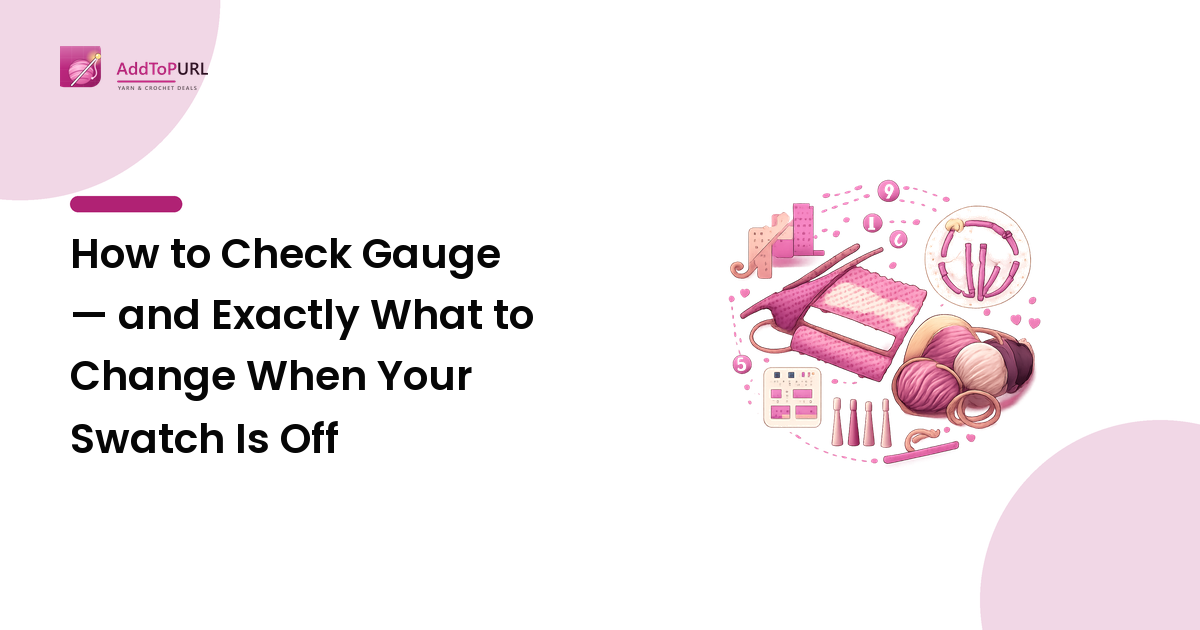
The takeaway up front: gauge is how many stitches and rows fill four inches (ten centimetres) of your fabric, and it is personal to you, your yarn, and your hook or needle. Make a swatch at least six inches square in the pattern stitch, treat it exactly as you'll treat the finished piece — including washing and blocking — then measure in the middle. Too many stitches across four inches means your fabric is tighter than the pattern's, so go up a size; too few means go down. If that's all you take away, your next fitted project will fit.
What gauge actually is
Gauge (called tension in UK patterns) is stated in every pattern as something like "20 sts and 28 rows = 4 in / 10 cm in stockinette on 4.5 mm needles." Three parts matter:
- The stitch count — how many stitches occupy four inches horizontally. This governs width, and width is what fit depends on.
- The row count — how many rows occupy four inches vertically. This matters less for garments worked to a length ("work until piece measures 14 in"), and a great deal for anything shaped by row counts, like a raglan yoke or a top-down sleeve cap.
- The stitch pattern and tool size — the conditions under which those numbers were achieved. A gauge measured in single crochet tells you nothing about your double crochet gauge, and vice versa.
The ball band's suggested gauge is a different thing again: it's the yarn manufacturer's rough guide for that yarn in a basic stitch, useful for reading a yarn label and for sanity-checking a substitution, but the pattern's stated gauge is the one you have to match.
Why your gauge differs from the designer's
Nothing is wrong with you. Gauge varies for ordinary reasons: how firmly you hold the working yarn, the material of your needles or hook (slick metal usually runs looser than grippy bamboo), whether you're relaxed or tense, whether you're working flat or in the round, and — most of all — the specific yarn. Two yarns in the same weight category can behave differently enough to change the numbers, which is why the yarn weights and fibers guide treats the category as a shortlist rather than an answer.
Make a swatch that tells the truth
Swatching only lies when the swatch is made under different conditions from the project.
Make it big enough. At least six inches (15 cm) square. Edge stitches distort — they pull in or splay out — so you need a margin of undisturbed fabric around the four inches you're going to measure. A three-inch swatch is mostly edges.
Use the pattern's stitch. If the gauge is given in a lace, cable, or half-double-crochet pattern, swatch that, not stockinette or chain-and-single-crochet. Textured stitches pull in; cables especially.
Match how the project is worked. If the piece is knitted in the round, swatch in the round — many knitters have noticeably different knit and purl tension, so a flat swatch misreports their in-the-round gauge. The shortcut is to work flat but slide the stitches back to the right end each row, carrying the yarn loosely across the back, so every row is knitted.
Use the yarn you'll actually use. Not a similar one from the stash, and if you can help it, not a different colourway — some deep dyes behave differently.
Then wash and block it, exactly as you'll treat the finished piece. This is the step people skip and the one with the biggest consequences. Cotton and linen commonly relax and grow; superwash wool is notorious for lengthening once wet; textured stitches open up. A swatch measured straight off the needles can be a full stitch per inch away from the fabric you'll wear. Wet it, lay it flat without stretching, let it dry completely, and measure it dry. Our blocking and care guide covers the method per fibre.
Measure it properly
- Lay the swatch flat on a hard surface, unstretched, right side up — never in your hand or on your lap.
- Put a rigid ruler across the middle of the swatch, at least an inch in from every edge.
- Count the stitches across four inches, including partial stitches as fractions. "Twenty-one and a half" is a useful answer; rounding to 22 loses what you need.
- Repeat vertically for rows.
- Measure in two or three spots and average them — fabric is not perfectly uniform.
The arithmetic: what your gauge means in inches
Here is why half a stitch matters. Suppose the pattern gives 20 stitches to 4 inches — that's 5 stitches per inch — and the back of the sweater is 100 stitches.
- At the pattern's gauge: 100 ÷ 5 = 20 inches wide, as designed.
- Your swatch gives 22 stitches to 4 inches (5.5 per inch): 100 ÷ 5.5 = 18.2 inches. Nearly two inches narrower on the back alone — close to four inches missing from the finished circumference.
- Your swatch gives 18 stitches to 4 inches (4.5 per inch): 100 ÷ 4.5 = 22.2 inches, and the same again on the front.
Four inches of circumference is the difference between a size that fits and one that doesn't. That's the whole argument for swatching, in one calculation.
Fixing an off gauge
Too many stitches per four inches = your fabric is tighter than the pattern's = go up a needle or hook size and swatch again.
Too few stitches per four inches = your fabric is looser = go down a size.
A useful rule of thumb: one size change tends to move gauge by roughly half a stitch per inch — about two stitches per four inches. So if you're two stitches out over four inches, try one size; if you're four out, try two sizes. It's an approximation, not a law, so re-swatch rather than assuming.
If you're between sizes, or a size change overshoots, you have three further levers:
- Change the tool material. Switching bamboo to metal, or back, shifts many people's tension by a useful fraction at the same size.
- Recalculate the stitch count. Work at whatever gauge gives fabric you like, then cast on for the width you want: desired width × your stitches per inch. For a 20-inch back at 5.5 stitches per inch, that's 20 × 5.5 = 110 stitches, adjusted to the pattern's stitch multiple. It means recalculating shaping, so it suits simple shapes best.
- Choose a different size in the pattern. If your gauge runs tight, the next size up may work out to your intended measurements. Check the schematic's stitch counts and do the division.
And if the fabric feels wrong at the gauge that matches — stiff and boardy, or loose and floppy — believe the fabric. A drapey shawl and a hardwearing bag want different densities. Change the yarn rather than fight it.
When you can skip the swatch
Sometimes, honestly. Scarves, blankets, dishcloths — anything where a couple of inches either way doesn't matter — can be started straight away; you'll just use a little more or less yarn than the pattern says. Swatch every time for garments, hats, socks, gloves, and any substitution, because that's where fit or yardage punishes you. Amigurumi is its own case: gauge matters less for size than for density, since loose fabric lets stuffing show through.
FAQ
How big should a gauge swatch be? At least six inches (15 cm) square, so you can measure four inches from the middle with a clear inch of undisturbed fabric on every side. Bigger is better and more accurate; smaller is mostly edge distortion pretending to be data.
Do I really have to block my swatch? For anything you'll wash — so, essentially anything wearable — yes. Cotton, linen and superwash wool can change measurably once wet, and a swatch measured off the needles is describing a fabric that won't exist by the time you wear it.
What if my stitch gauge matches but my row gauge doesn't? Usually fine, and very common. Prioritise stitch gauge, because width is what fit depends on. Row gauge only becomes critical when the pattern shapes by row counts rather than by measurement — yokes, raglans, sleeve caps — in which case work to the stated measurements where the pattern allows it, and recalculate rows where it doesn't.
Should I unravel my swatch to save the yarn? Keep it, at least until the project's done — it's your record of what you did and useful for testing how the fabric washes. If you're tight on yardage it can be unravelled, but the yarn will be kinked and won't behave identically.
My gauge changed halfway through the project. Why? Usually tension drift — you relaxed as the piece got familiar, or tensed up during a fiddly section. It also happens when you switch needles mid-project or pick up after a long break. Check your work against the swatch every few inches on anything fitted.
Cast on with confidence
Twenty minutes and one small square is the whole cost of knowing your finished piece will measure what the pattern promised. Make it big, work it in the pattern stitch, block it, measure the middle, and do the division that converts stitches per inch into inches of garment.
When your swatch tells you it's the yarn or the tool that needs to change, compare curated yarn shops, needle and hook listings, and current deals on AddTopURL — retailers and categories side by side so you can find the right weight or the next size up without hunting shop to shop. AddTopURL earns an affiliate commission on retailer links; it never changes what we recommend.